What’s actually landing on Middle’s doorsteps.
In 30 seconds
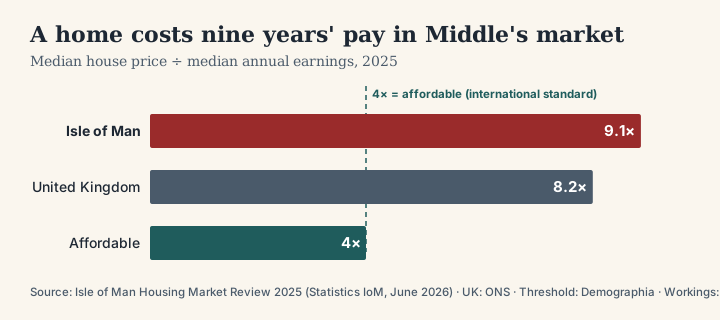
- A median home here costs 9.1× median earnings — still more than double the standard affordability threshold. At Braddan Woods only 80 of 320 homes, one in four, are “affordable”, and the infrastructure isn’t yet real: I’ll publish the exact wording of every commitment attached to it and track each one. The school, for instance, was never promised: it has “approval in principle” only. I’ll track what was promised, and push what wasn’t into the open.
- Commence the landlord registration law that's sat unused since 2021, and publish the breakdown of the roughly 5,700 properties the Census counted as vacant.
- Childcare stepped towards funded provision from nine months, faster, less adversarial and child-first family law, and apprenticeships built into every publicly-supported home.
Housing, family, the next generation, and the skills to build and staff all of it — plus how I’d actually work if you send me to Tynwald. Everything here is a commitment with evidence behind it and a link to check it yourself.
1 · Braddan Woods: right-size it, and build what was promised
The Island needs working families to be able to stay. A median house here now costs 9.1 times median earnings; for an 18–25 year-old on one income it’s about 10 times. Braddan Woods is 320 homes next to Braddan School, and I have two concerns about it. Affordability: only 80 of the 320 homes, one in four, are “affordable”, when affordability is the whole problem. Infrastructure: a single access junction onto Braddan Road, with the Ballafletcher Road link only a “potential future” one; a school that was never promised — the permission (22/00675/B, decision issued 17 January 2024) grants only “approval in principle for a 2-form entry primary school”, which DESC would have to take forward itself, with its own business case and funding, and Condition 3 gives it until 17 January 2028 before that approval simply lapses; the Peel Road crossing the estate’s traffic will depend on; and the questions Braddan Commissioners raised at appeal and never had answered — GP capacity, school places, flooding and drainage. Ballasalla shows how that kind of gap goes: a bypass built in 2023 that won’t open to the public until 2027, and a school that needs mobile classrooms. Before we concrete more fields, I want answers on the roughly 5,700 properties the 2021 Census counted as vacant on census night — some of that will be second homes or gaps between tenancies, not spare capacity, but nobody has published the breakdown, and we should have it before we assume either way. (I used to say I backed the scheme as it stood; I’ve changed my mind, and logged it.)
What I’d do:
- A public delivery tracker for Braddan Woods: the exact wording of every commitment, whether it’s a “will”, a “may”, or was never there at all, tracked as built and flagged in Tynwald when it slips. First entries: the Peel Road crossing, due before the first home is occupied; the cycle route, due by the 100th; and the school clock, where DESC must apply by 17 January 2028 or its approval in principle lapses. On school places I won’t promise a building sight unseen, but demand from the estate should be planned for and met properly, not patched over with another mobile classroom, the way Ballasalla’s was.
- Commence the landlord registration law that’s sat unused since 2021, aligned with UK minimum standards so lets over 30 months can’t be handed out with damp and mould still in the walls — the same conditions that end up costing the health service — and get to the bottom of the vacant-property numbers.
- Renting. Many of the working families who keep this Island running rent rather than buy, and starter homes alone don’t help a family renting today. Alongside the register: security of tenure, protection from no-fault eviction while a tenant is paying and behaving, and longer default tenancies; a deposit protection scheme, deposits held by a third party and returned by default unless damage is evidenced; and rent transparency, not rent control: publish rent data by area and property size, and investigate where rents stay stubbornly high. I don’t believe rent caps work on an island short of homes. I do believe watching the numbers does.
- Keep homebuilding like Braddan Woods protected from being bought up wholesale by external investors and market power — new supply should go to people who’ll actually live in it.
- Back a tradesperson-led self-build scheme that trains apprentices as it builds — housing delivery and the construction skills shortage, solved with the same idea.
More on the numbers behind all of this is on the Observatory’s homes and housing work.
2 · Family, childcare and mental health
Childcare: 574 babies were born here in 2024 — the fewest since 1918. If we want young working families to stay, childcare has to work. The Childcare Credit was a good start; I’d support extending it step by step towards funded childcare from nine months for working families — an investment of roughly £10–20m a year that pays back through parents staying in work and families staying on the Island — and review the under-2 premises and ratio rules that the Government’s own Childcare Strategy calls the single biggest inhibitor of nursery viability, without lowering safeguarding or staff standards. I won’t promise childcare alone raises the birth rate, but I will promise to work towards the Island being an attractive place to raise a young family while working.
Family law: long, adversarial divorces are hardest on the people with the least say in them — the children. I want every divorce to put the child at the centre from day one, and the first port of call to be mediation and resolution, not an advocate’s office. The whole process should move as fast as possible away from an adversarial one and towards a resolved one — financial and parenting arrangements settled together, within 26 weeks. Ending years-long courtroom combat protects children, reduces the scope for post-separation abuse, and funds itself: money spent on the reactive system moves to the proactive one. Where children are involved, I’d also fund early, non-judgemental support for separating parents in the weeks it matters most — backing the third-sector groups already doing this, not duplicating them.
Mental health: do what works. Financial security and community are protective — so economic and community policy are mental health policy — and I’d back part-funding of the community-supported spaces already doing the work. The specifics — measuring worklessness properly, stepped care, publishing the metrics that actually matter — are set out in full on the Health & Care page.
Resilience and relationships: I’d push for secondary PSHE to properly cover two things — how other people think and process the world differently (neurodiversity), and mental health resilience specifically. RSE itself is advisory, not statutory, so every school sets its own withdrawal policy — and they don’t agree. Most let parents pull their child out of the whole programme; only one school I checked keeps sex-education separate from the relationships and safeguarding content. I’d ask DESC to fix that inconsistency: make what a healthy relationship looks like, and what isn’t one, mandatory alongside health and safeguarding in every school it runs, with parents keeping a clear right to withdraw their child from sex-education specifically, nothing more. The RSE curriculum that resumed here in 2024 already publishes lesson materials to parents before they’re taught; I’d keep that same openness for anything added on top of it.
Samaritans 116 123 (free, 24/7)
SHOUT text 85258 (free, 24/7)
Isle Stand Up To Suicide 803040 (2pm to 10pm)
Papyrus HOPELINE 0800 068 4141 (for anyone under 35, or worried about a young person)
Isle of Man peer & community support:
ManxPACT Saturdays, 10:30am to noon, at Costa (Ramsey) and the Sea Terminal (Douglas)
Ed Space (men) Thursdays, 7pm, venues around the Island
Women’s Talk Tuesdays, 7pm, around the Island
3 · Migration, borders and crime — and an Island our kids can stay for
People worry about who’s arriving; I worry at least as much about who’s leaving. The census shows the pattern plainly — and it’s the same pattern behind my own research, The Island That Stopped Growing: disproportionately younger local people out — the Island imports older, specialist workers because it fails to inspire and keep its own. Migration isn’t the enemy; an economy that gives our young people no reason to stay is.
What I’d do:
- ID and advance passenger information at the border, now — and made a legal requirement. Support and finish the border-security work already under way, within Common Travel Area rules, then put it on a statutory footing rather than goodwill. This is first and foremost about drugs and organised crime: our police can’t intercept what they can’t see coming. And insist the coming facial-recognition legislation arrives with the strongest data-protection safeguards alongside it.
- Close the routes that are open to abuse, and being abused, and check after landing. Shut down the ways in that get least scrutiny and are being exploited, and properly fund the Island’s new Immigration Compliance Team to follow up on people here on work and residence permissions after they’ve arrived — its first year took immigration arrests from two to twelve.
- Migration tied to the economy — and tighter. If a job can be done by someone already settled here, it should be offered there first; that’s how an island runs at structural full employment. And the discipline that runs through this whole site applies here most of all: measure unemployment, underemployment and migration properly, then manage them. We cannot act on a constraint we do not measure.
- Deport foreign criminals — and be straight about the limits. Where a foreign national is convicted here, dealing drugs to the Island above all, the court can recommend deportation and a deportation order can follow — and it should: our prison does not have the capacity to hold everyone who tries to earn a living dealing drugs to the Isle of Man. Honesty matters too: British citizens can’t be deported, and much of the drugs trade into the Island is run from Britain — which is exactly why the border checks above matter most.
- An Island our kids can stay for. Build the skills-and-homes ladder above — apprenticeships, clinician routes, tech infrastructure with resilient power and connectivity — and look carefully at the rules around school-age work, so it’s simple and safe for teenagers to take part-time jobs in retail and hospitality: the first rung of working life here, not red tape.
For the people the Island asked to come here. The border checks above are about drugs and organised crime, not about the families who live and work here lawfully. My principle on migration is a workforce shortage in a key area, while we train our own, and health and care are the plainest example of such a shortage: the people staffing Noble’s and our care homes are here because we needed them. When I say a job should be offered first to someone already settled here, “settled” means where you live and work, not where you were born. The workers we recruited into shortage roles should have a clear, predictable route to settling here with their spouse and children, and closing the routes being abused protects them: when a route is exploited, it is the honest worker who ends up under suspicion. I’ll push for simpler rules, not new barriers; a complicated system produces mistakes, and that is unfair to everyone. I’m not promising a change to who qualifies. I’m promising clarity. This section is also available in Tagalog.
4 · Training and skills, planned around who we’ll actually need
The construction sector says apprenticeship uptake in the trades fell after the 2024 funding changes — Government disputes that, and quietly extended funding back to larger employers in September 2025, at exactly the moment construction, health and care all need more skilled people, not fewer. It shows up in the price: Treasury’s own commissioned report found construction costs here already 18% above the UK average, comparable to Outer London, with tender prices forecast to rise a further 7.5% in both 2026 and 2027 (source: Manx Radio). A shortage of skilled trades pushes prices up as directly as it pushes waiting lists up. This connects directly to housing (above) and to an ageing Island where the working-age population is under growing strain.
What I’d do: demographics-driven planning for clinicians, trades and STEM routes, and use publicly-supported housing delivery to require apprenticeship placements as a condition of the funding — turning every home built with public support into a training placement too.
5 · SEN: additional educational needs, in law
England has a statutory SEND code and an independent tribunal. The Island runs on the Education Act 2001 plus departmental practice: the AEN code that would guarantee support was drafted and consulted on in 2020, the Education Bill it depended on was withdrawn in 2021, and it never became law. No enforceable entitlements, and no independent appeal. Much of what parents experience follows from that. The dyslexia petition took six years to produce twelve recommendations, and in June Tynwald overruled the Council of Ministers to pass all twelve, with a progress report due in December (Manx Radio). ADHD and autism assessment waits have come down from around two and a half years to around one, and a year still gates a child’s support at school. Castle Rushen High’s specialist provision centre more than doubled its enrolment in twelve months (3FM).
What I’d do: the Education (Amendment) Bill, with personalised learning plans and an independent appeals mechanism for AEN, was part way through the Keys when the House rose, so the next House inherits it (Manx Radio). Finish the Bill, make the code statutory, and publish the assessment waiting times so everyone can see whether it is working. I’m actively researching this one, including with people who work in it, so expect this position to sharpen.
How I’d actually work in Tynwald
There’s no point in changing the people without changing the system.
Push to simplify Government itself. The system doesn’t work for the people in it, and it doesn’t work for us. Project governance rules need to be simple, clear and consistently applied, so projects don’t run out of control. Contracting rules need the same: one clear, centralised standard set by Treasury, with every department and agency mandated to follow it. Projects and agreements that expose the Island to long-term liability or risk should require independent review, mandated in law.
Government’s mandate shouldn’t be formed by post-election horse-trading behind closed doors. I’d push for government that builds consensus using policy science: within a month of the election, the real options set out and published — costed, tested, compared using the same kind of transparent, checkable modelling behind my Observatory’s economic work. By November, a full programme for government open for everyone’s comments — and genuinely acted on, not a rubber stamp.
And if the process works, we can wire it into our democracy — and be completely transparent about what we ask the electorate to vote on every five years.
We’re a community. We don’t need to shout across a room to get something done.
And locally? Two commitments that start on day one, whatever else happens: a constituency surgery every week, with a surgery at or near Noble’s for shift workers on request, and every letter and email answered within three days — with my professional skills available, free, to our local Commissioners.