Visualise how Government spends — and the size of the state.
In 30 seconds
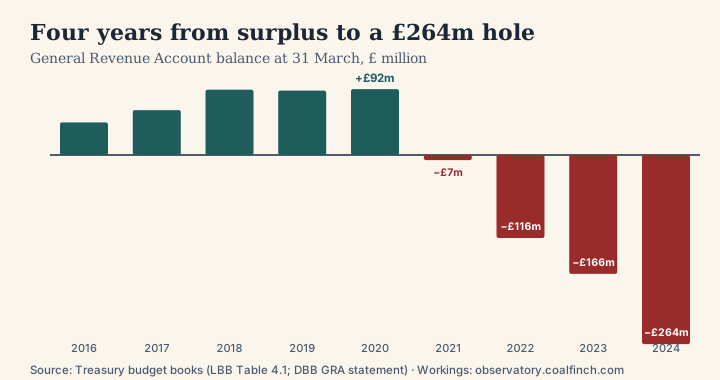
- The account that pays for day-to-day Government went from a £92m surplus (2020) to a £263.9m deficit (2024), and Budget 2026 draws £126m from reserves to balance the books.
- A £3.06bn unfunded pension liability is disclosed but never consolidated into one number you'd actually see. Every liability belongs on the balance sheet.
- A plain-English “where it went” report every time the numbers move, and a headcount cap that excludes frontline clinical and care staff.
This page is about the Government’s own finances, not the wider economy — what it takes in, what it owes, and how many people it employs to do it. (Growth, cost of living and energy are on the Economy page.)
1 · Visualise how Government spends
This is a key issue, and one everyone needs to be engaged with. Government is spending more than it raises, and each year’s gap is closed by drawing on reserves — £126m of them in 2026-27 alone — this is never shown as one connected picture. The General Revenue Account’s own balance has gone from a surplus of £92.0m (2020) to a deficit of £263.9m (2024). The dedicated pension reserve ran dry in March 2023. And there’s a £3.06bn unfunded pension liability that doesn’t appear in any single headline Treasury figure — it’s disclosed, but never consolidated into one number you’d actually see. That figure also leans on the Government’s own migration assumptions: the discount rate used to calculate it carries roughly a one-percentage-point uplift tied to expected inward migration, worth an estimated £438m of the total. Take that assumption out, and the liability is that much bigger. None of this is secret — it’s all in Treasury’s own accounts. It’s just never been joined up before — which is why I joined it up: ten years of accounts, one screen, at the Observatory, with the full economic story in The Island That Stopped Growing, and projections on both the Manx State Pension and the Civil Service Pensions — which are paid out of departmental budgets.
The pension figure is the clearest example of a wider habit: plans quietly built on the assumption that the population keeps growing. That assumption may well be reasonable in some places — but reasonable or not, it should be stated, not buried in a discount rate or an unspoken business case. So I’d go further than the pension number alone: any Government policy that depends on continued population or migration growth should have that dependency explicitly identified, and the review or implementation of every policy should include a deliberate step that asks — does this only work if more people arrive, and what happens if they don’t? I’m not claiming to know which policies are exposed beyond the pension figure; the commitment is that we find out, and say so in the open.
What I’d do:
- Publish a plain-English “Where it went” report every time the numbers move — what came in, what went out, what changed, explained simply enough that you don’t need an accountant to follow it.
- Push for Government accounts to full international standards, readable by anyone, with every liability on the balance sheet — no off-balance-sheet surprises like the pension gap again.
- Make departmental Chief Executives and finance officers formally answerable for the financial viability of their own departments, so management’s incentives finally point the same way as yours — with proper project controls, and contracts that explicitly cover that viability, not just delivery.
- A central Governance function for simplified Government contracts and rules — not a new department, but sitting under the Cabinet Office or Treasury, alongside Procurement Services, much as the Office of Human Resources already works across Government — so contracting standards, project controls and enforcement are consistent, instead of scattered department by department.
- Publish what’s already been agreed between third parties and the Department of Infrastructure and Treasury Ministers, going back to 2015 — so we can actually learn from the commercial and project-governance mistakes already made, instead of repeating them quietly.
- Publish a standing risk assessment of Government’s reliance on FERSA, the VAT and customs revenue-sharing arrangement with the UK worth roughly £400m a year, about a third of total revenue. What it’s worth, what changed it before (the UK rebased the formula twice already — 2009 and 2011 — cutting the Island’s share by roughly £349m a year in real terms, a 46% drop), and what the contingency plan is if it’s tightened again — reviewed every time HM Treasury reviews the arrangement itself.
- Publish the actuarial assumptions behind the £3.06bn pension liability in full, including the migration-linked uplift to the discount rate above — if the number depends on people continuing to arrive, say so plainly, don’t bury it in a discount rate.
- Make the population-growth assumption declare itself, everywhere. Build a deliberate step into the review and implementation of every policy that identifies any dependence on continued population or migration growth, states it plainly, and shows how it’s handled if the growth doesn’t come — the same discipline already promised for the pension figure, applied across Government.
- Report the State Pension and the Civil Service Pension on the same basis, side by side. Both run pay-as-you-go: today’s contributors and today’s budgets cover promises made to the generation before them, which is exactly why a shrinking or ageing workforce is a problem for both, not just the one with a fund that can run dry. Same transparency, same planning, for both.
I will only accept accounts that are clear to you, the public. Treasury’s own accounts run to literally thousands of pages of PDF — nobody reads that, not you, not most Members, not half the Civil Servants who have to produce it. The alternative already exists: ten years of accounts on one screen, built and published at the Observatory. That’s the standard — a single, digital, always-current platform, not another PDF to file away unread.
None of the commitments across this site are free, and I won’t pretend they are. Where I’ve put a cost on something — childcare, bowel screening — it’s an estimated range, not a guarantee dressed up as a promise, and it has to be weighed against the deficit and pension gap on this page, not ignored alongside them. The same discipline I’m asking Government to apply to itself — cost it, publish it, before you commit to it — is the discipline I’ll hold my own proposals to before asking you to back them at the polls.
On tax specifically: I don’t think it’s a question you can answer on its own. The real question underneath it is whether we can sustainably fund a health and care system that’s free at the point of use — which I want to keep — given the deficit and pension pressures on this page. That has to be a public conversation, grounded in what things actually cost, not a rate picked first and worked backwards from. I’m not going into this election promising a tax rise, or ruling one out; I’m promising that conversation happens in the open, tied to the real numbers, not decided quietly and announced after the fact.
2 · A public sector sized for the Island we actually are
Our population is roughly what it was fifteen years ago, and by several measures the public sector is no more efficient today than it was in 2011. At the same time, “bloated public sector” is a doorstep line that’s more complicated than either side admits: most public-sector employee cost is Health & Care and Education, not sprawling bureaucracy. I’d rather show you the breakdown than assert it.
What I’d do:
- Re-introduce the Government headcount cap — excluding frontline clinical and care staff, where the Health page sets out where more people are actually needed — managed through natural turnover, not redundancies.
- Publish the departmental staffing and cost breakdown, benchmarked against Jersey, Guernsey and comparable UK authorities, so “bloated” becomes a testable claim rather than a slogan either side can just repeat.
- Insist on a published 15-year workforce plan from Education and Manx Care together: how the Island trains, recruits and retains the people its services will need over the next 15 to 25 years, instead of discovering each shortage at the point of crisis.
What actually funds the services this pays for — growing the economy, above all its export sectors — is on the Economy page.
Check my working — the Observatory
Every figure above comes from a public source and most of them from tools you can go and check yourself at observatory.coalfinch.com — ten years of Government accounts on a single screen, instead of 2,500 pages.