An economy Middle can invest in.
In 30 seconds
- Twice we’ve run the same “attraction loop” — outside money in, public sector and costs scaled up to match, first on the VAT arrangement to 2009, then on e-gaming — and each time round, the private sector underneath eroded and the hole got bigger. Our economy is now costed at an e-gaming rate the revenues no longer support.
- A public sector we can afford depends on growing what we export. That, not another efficiency drive, is what funds the services we want — and it’s the only honest way to fill the gap the last administration left.
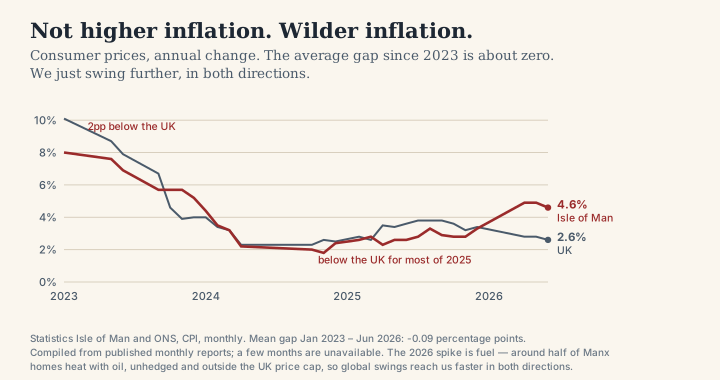
- Week to week, bills still bite hardest: our inflation isn’t higher than the UK’s on average, it’s wilder, because around half of Manx homes heat with oil. Net Zero yes; the 2030 electricity deadline no. Judge every energy project on cost per household, resilience, and our actual capacity to deliver it.
Here’s my test for any economic policy: is it fair, and would you invest in it? Not “does it win a doorstep” — would a person putting their own money in look at the plan and the numbers and say yes, and would a young person actually consider coming back to the Island to buy a home and build a career here. That’s what “investible” means to me: a cost base that doesn’t quietly erode what people earn, and a private sector — above all its export businesses — growing enough to fund our public services. (The Government’s own finances are their own page: Fiscal.)
1 · The cost of living — bills, not just tax
Cost of living isn’t only wages and rent — it’s the price and reliability of the connections an Island depends on by definition. Manx inflation isn’t persistently higher than the UK’s — averaged across the last three and a half years the gap is roughly nil, and for most of 2025 we were running below it. What we get is bigger swings in both directions, because around half of Manx homes heat with oil: unhedged, unregulated, and outside the price cap that smooths this for UK households. Right now that’s hurting — 4.6% in June against the UK’s 2.6%, with oil and other fuels up over 73% in a year and petrol up 22%. A March 2026 survey found only 1 in 5 Islanders satisfied with the cost of getting on or off the Island. The Steam Packet raised its freight fuel surcharge by 25% from 1 April 2026 — £2.27 a lane metre — with businesses still asking how the surcharge is even calculated and Government ruling out help, and the new Sea Services Agreement Tynwald asked for by the end of 2025 is still unsigned.
What I’d do: doggedly pursue the market power that quietly adds cost to every household — mortgage margins, land-banking, the rental market, telecom and utility pricing; publish the Steam Packet surcharge calculation and push the overdue Sea Services Agreement to signature; and no stealth taxes — no services or costs pushed from general taxation onto your rates without your local authority’s agreement (“Clause 5” should stay stripped from the Local Government Bill).
On energy and Net Zero: I support the goal of Net Zero. I don’t support the 2030 electricity decarbonisation deadline. An arbitrary interim deadline forces the early retirement of plant, equipment and investment well before the end of their working life — it’s a target that reads well in a press release and fails as policy almost immediately: greener as a slogan than as a plan. The 2030 clean-electricity pledge was set without a delivered plan behind it — the 30MW renewables target has produced about 7MW. Keep the destination; drop the artificial deadline; judge every major energy investment on evidence — cost per household, resilience, and our actual capacity to deliver it. (I’ve set out the trade-offs in more depth in Powering Mann, my own exploratory analysis at the Observatory.) Attorney General guidance restricts candidates from commenting on the live Mooir Vannin application itself, so I won’t — but that framework above is exactly how I’d judge it, or any other project, once I legitimately can. That said, unless there’s good reason otherwise, whatever’s already been committed by the Department of Infrastructure should be made public, and the governance rules updated so this can’t happen again without central Government authority.
There’s no need to decide the Island’s energy mix before September 2026. My view is to retain optionality, and invest where necessary to build a resilient, connected future for the Island — power interconnects and fibre interconnects both included.
2 · Growing what we export
A public sector we can afford ultimately depends on growing the economy — above all its export sectors — because that, not another efficiency drive, is what ultimately funds the public services we want. That includes genuine public-private partnerships, co-owned by Government and entrepreneurs, that open assets like Manx Care’s expertise into export businesses — and then letting the entrepreneurs get on with it. (Partnerships like that only work under proper commercial controls, in the open. The transparency commitment, publishing what’s been agreed with the Department of Infrastructure and Treasury Ministers since 2015 so we learn from those mistakes rather than repeat them quietly, sits where it belongs on the Fiscal page, alongside the headcount cap and the staffing benchmark.)
One of the few levers Government already holds is its own spending in the local market rather than direct to the UK — used deliberately, alongside easier access to Government departments, it can help Manx businesses grow into exporters.
3 · Filling the hole
I’ll be honest with you: filling the economic and fiscal gap the last administration left is not an easy task. The numbers are what they are — Government spending more than it raises, £126m drawn from reserves in 2026-27 alone — and nobody standing in Middle this September has a painless way out. What I can offer is a diagnosis, and a direction that follows from it.
The diagnosis first. Twice now we’ve run what I call the attraction loop: find a source of outside money, build the public sector to the size that money supports, and let the cost of everything — wages, premises, Government itself — settle at the boom sector’s rate. Up to 2009 the outside money was the VAT arrangement, and it was public spending itself that drove costs up. Since then it has been e-gaming: pursued hard — to a point — and then left to seek its market access elsewhere. Each pass, the private sector beneath the favoured one erodes a little further, because it has to carry boom-rate costs without boom-rate revenues. Our economy is now costed at an e-gaming rate, but the revenues are no longer there to support it. That is the hole. And every time we run the loop, it gets bigger.
So the answer can’t be a third pass of the same loop. I’ve argued elsewhere that incentivising a new sector into an economy already at its limits of people, homes and capital produces gains that don’t last. But that is an argument against conjuring sectors from scratch — it says nothing against redeploying skills we already have and already pay for. E-gaming built a particular skillset here: platform engineering, payments, real-time data, security, compliance at commercial speed. Those skills have obvious adjacent markets — cybersecurity, cryptography, data and AI services — and some less obvious ones that fit our existing base: regtech and AI-assurance, where our regulatory ambitions and EU data-adequacy status since January 2024 give us something real to sell; digital-asset custody, building on regulatory experience we already hold; and health-data analytics, which connects to an idea I’ll come back to below. Our small space-sector footprint may offer a niche in satellite data too, though I hold that one more loosely. I’m not claiming to know which of these takes. The point is the direction: build markets for the skills already on the Island, rather than bid a new sector into an economy that’s full.
Two honest caveats. First, none of these really fly without broader market access — and to get that, we would have to agree to a measure of economic cohesion with larger markets. That is a real trade-off, it has costs, and it should be argued out in the open rather than slipped past voters. Second, new exporters need starter customers — and who better than the Isle of Man Government itself? It is one of the few levers we actually hold.
We should be equally clear about what we can’t do. We don’t have our own currency, so we can’t simply inflate our way out of this. What we do have is Government spending. This is not an argument for more spending — it’s an argument for spending directed by economic-sustainability questions. Where the money lands should be decided by asking: does this help a Manx business grow into an exporter, or does it flow straight off-Island?
In the same vein, many of the problems we face are public-sector problems — and that, oddly, is an opportunity. Solving them well rebalances the public/private split, and it treats public-sector problems as entrepreneurial opportunities: the genuine public-private partnerships I described above. But this comes with a warning. Our public-sector problems must be relevant elsewhere for anyone to pay us to solve them — and very specifically, Manx Care must be relevant to the NHS, and must catch up operationally first. Nobody buys expertise from a system that can’t yet run itself well.
What might that pattern actually produce? The NHS isn’t perfect — there are problems there that we could, conceivably, get to solve here first. That’s the caveat above working for us rather than against us: catching Manx Care up operationally isn’t just the price of entry, it’s where the opportunity starts. Here’s another idea in that neighbourhood — an opportunity, not a commitment. The Isle of Man is well placed to offer a one-week health reset: a short, easy trip built around healthy meals, daily exercise — Pilates, coastal walks and cold-water swims — and a structured set of health tests, so that a visitor leaves with both a proper break and a clear, data-driven picture of their health, and a plan to take home. It would use skills we already have in hospitality, health and data; it would sell to visitors rather than residents; and it would give our health-data ambitions a paying market. Whether the demand exists at a price that works is exactly the kind of question I’d want tested and shown in the open before a penny of public money followed it.
What I’d do:
- Name the hole and track it. Publish the gap between what our economy costs and what it earns on the Observatory, and measure every economic proposal against closing it.
- Point Government spending at exporters. Not more spending — the same spending, tested against one question: does this help a Manx business sell off-Island? Make Government the starter customer for the sectors our skills can reach.
- Put the market-access trade-off in the open. Adjacent sectors don’t scale without broader market access, and that means an honest public argument about economic cohesion — costs included.
- Treat public-sector problems as export opportunities — carefully. Only where the problem is relevant elsewhere; and for Manx Care, relevance to the NHS begins with catching up operationally.
4 · Agriculture and fishing — supporting the skills, honest about “self-sufficient”
The Island shouldn’t lose the skills and land management that come from farming and fishing, generation to generation. That loss is real, and worth actively supporting against. It’s also no accident: agriculture and fishing shed 186 jobs between the 2011 and 2021 censuses, part of the pattern the 2010 model predicted for the industries most exposed when Government targets favourites and lets them bid land, labour and costs away from everyone else. The same analysis points to the fix: follow the UK, improve market access, and let the cost side of the equation come back into balance, so farming returns to a sensible level rather than being propped up or mourned. Some of the loudest calls for the Island to be “self-sufficient” — in energy, in food, sometimes both — are not realistic. We are economically integrated with the UK: our public services are funded through financial arrangements with the UK, and our lights stay on through cables to the UK. That’s not something we can move away from without consequence. I support the goal behind “self-sustainable”: keeping the skills, the land and the industries alive. I won’t pretend it means cutting ourselves off from the arrangements that fund and power everything else on this site. (What the UK revenue arrangement is worth, and how I’d manage the risk of depending on it, is on the Fiscal page.)
What I’d do:
- Support fisheries and agricultural grant schemes sized to actually keep skills and small operators viable — not just headline totals.
- An abattoir function is clearly needed — and if it can be provided on-Island, that’s obviously preferable. The 2022 review fixed the culture and the sales model — it didn’t review the operational model or the plant itself. In July 2024, a freezer failure — older equipment, temperature drift despite recent servicing — cost £40,000 in meat and triggered a food-safety recall, and a separate cattle-hoist failure held cattle for over a week, on top of another breakdown the month before. I have some starting principles — resilience designed in rather than bolted on after each failure (questions like whether redundancy through smaller, distributed units beats one large point of failure), equipment professionally and proactively maintained, and whoever runs it rewarded for the service farmers actually experience, not just headline throughput — but I’m not going to pretend I have the fix from the outside. And reliability isn’t only an engineering question: demand for the service depends on farmers’ willingness to invest in their cattle, which is in turn a function of their confidence in the market — knowing what the abattoir costs is one thing; knowing it will actually be there is another. I’d want to talk to farmers, the people running the plant, and the businesses that depend on it before committing to specifics.
- Use the boat. No scheme today supports moving livestock or produce off-Island; farmers pay close to £5,000 a wagon to export (Agriland) while the plant they depend on draws roughly £4m a year in public money, over £20m since 2008 (3FM). When a sailing has spare capacity, carry Manx livestock, meat and produce at the incremental cost of taking it. The farmers’ union has asked for a haulage equivalency scheme; this is the cheapest workable version of it, and it gives farmers a second route to market, so the plant has to earn its custom. Stabilise farming first, then work out what is actually worth investing in at the plant.
- The same test applies to the Island’s only flour mill and any other “strategic” food infrastructure: a business case made explicit, not assumed on the sentiment that local is always better. That doesn’t have to mean profit alone — food security and resilience can count too.
5 · Connectivity: the boat and the flights
The ferry is our road. Ferry users are repaying the £154m Treasury lent the Steam Packet to buy the company and build Manxman, £27.3m repaid so far (3FM), and the Liverpool terminal, north of £100m on a final figure Government won’t publish, feeds back into fares through port charges. Passengers pay it at the counter and freight passes it on at the till. That is a stealth tax on the cost of living, collected through the fare book. The freight survey the farmers’ union commissioned found Douglas–Heysham the dearest of the 15 routes it compared (Manx Radio), and the 25% fuel surcharge arrived this April with Government ruling out help.
What I’d do: the new Sea Services Agreement has slipped to 2027, so it lands on the next House (Manx Radio). Write it properly this time: freight prices regulated and the surcharge calculation published; reliability standards with teeth (rolling punctuality is 78%, with no consequence); oversight independent of the department that also operates the harbours; and the boat priced like infrastructure, not a profit centre, with an open, evidence-led analysis of taking the capital costs off the fares. Then use the capacity we already sail with. Empty deck space on an off-peak boat costs close to nothing to fill, and a monopoly never has to chase that price down, so it doesn’t. Price the spare space to fill it, offer it to Manx farmers and firms at the incremental cost of carrying it, and cap what captive travellers pay at the peak: surge pricing a funeral trip when there is no other carrier is the stealth tax again, in a different coat.
Flights: a London business day barely works any more. Loganair’s London City rotation gets there on the days it runs; the Gatwick timetable is shaped for leisure, because big jets only pay their way full. The Island has gone from 34 licensed banks to 11 since 2010, and the business demand that filled a morning flight shrank with them. Government’s own air services policy names London a core route and promises to intervene if necessary (gov.im), and it has done it before, underwriting a morning Heathrow rotation in 2020–21. What I’d do: hold Government to its own policy. A guaranteed morning-out, evening-back London rotation on right-sized aircraft, underwritten for a fixed term with published load targets, and the environment for hybrid IoM/South-East careers in finance and tech built alongside it, including tax treatment that keeps splitting a week between London and the Island simple. The Chamber’s warning stands: use the links or lose them (Manx Radio).
Check my working — the Observatory
Every figure above comes from a public source and most of them from tools you can go and check yourself at observatory.coalfinch.com — including the IOM Economy Story, the Economy Explorer, and the population and inflation trackers behind these numbers. Please do contribute — I’d love to hear from you.